

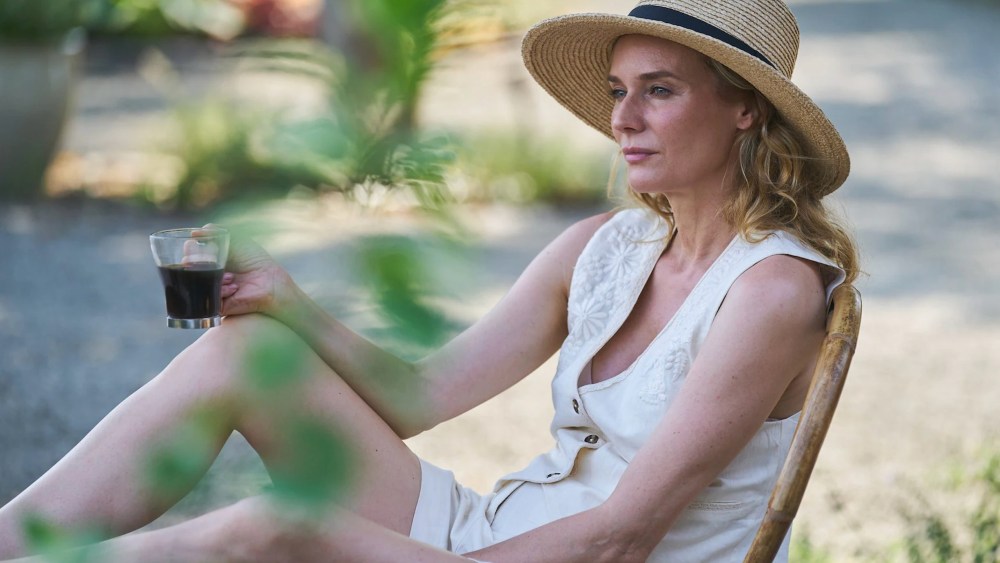
SPOILER ALERT: This story contains spoilers from “Little Disasters,” now streaming on Paramount+.
Over the past year, a cinematic trend has emerged that powerfully underscores the intense difficulties of motherhood. From “If I Had Legs I’d Kick You” and “Sinners” to “One Battle After Another” and “Song Sung Blue,” the challenges of being a joy-filled parent can rapidly intensify to an unbearable — and even a maddening — need to be a “perfect” mother. That plight is now being tackled on television in the limited series “Little Disasters” starring Diane Kruger. The six-episode series on Paramount+ illustrates the profound lengths a woman will go to protect her child while simultaneously enduring a significant emotional toll on herself, her marriage and her other children. Kruger has a theory as to why this trend in subject matter is happening — and why now.
“I’d like to believe it’s because more women are in decision-making positions and are greenlighting and validating different concerns or female storylines,” Kruger says. “I certainly think it’s a good thing, and it’s time that we take a look at that as well.”
The series follows the complex lives of four new mothers who become fast, longtime friends while all attending a birthing class. Based on Sarah Vaughan’s gripping 2020 novel, the series shows the raw realities of postnatal anxiety, parenting struggles, marriage dynamics and maternal OCD, while also stepping into the culture wars with the lead character’s skepticism about publicly funded healthcare and vaccinations. These illustrated challenges to mothers are authentic and deeply real: an exhausting, backbreaking relentless exercise of patience, selflessness and unconditional love.
In “Little Disasters,” a fragile bond shatters when one friend, Jess (Kruger), brings her baby daughter to an emergency room in the middle of the night when her persistent crying has her and her husband concerned their infant is sick. But there, Liz (Jo Joyner), an A&E doctor and close friend of 10-plus years, spots a head injury on the child. Liz faces an excruciating dilemma: report her longtime friend to social services or risk the child’s safety. She chooses the former. This single moment ignites a devastating chain of events, revealing how quickly a life-altering decision can fracture and destroy entire families and friendships.

From the get-go, Kruger’s Jess is an emotional wreck. Her explanation of the injury to the doctors and social services is not only sketchy, it’s unlikely, making her look like an unstable mother — and worse, a possibly abusive one. Her anxiety snowballs as the story rolls out over the weeks that follow.
Kruger says the role was exhausting, not only because of the subject matter but also because they didn’t shoot in episode order, “So we could go in a day from doing a scene where I think my child died, to 20 minutes later doing a lovely picnic.”
And it was also taking a personal toll on her, Kruger says: “The emotional extremes that were required almost broke me. Honestly, I said to my partner, ‘I feel like I’m having a burnout, like I’m overstimulated and overspent.’ But you know, on the other hand, I really felt the character was exploring very truthfully those very deep emotions. And especially when you are a mother, I think they rang really true. I was just able to lean into that. It didn’t require much for me to go there.”
Thankfully, she was able to shake those feelings when she returned to her real life as mom to a daughter with actor Norman Reedus. “Coming home, I have to say, I felt like it was easy — my home and my daughter was with me. We were filming over the summer, and so coming home to her happy little face every night felt like stepping into heaven.”

Jess’ struggle with the confusion of what really happened to her baby and the fear of the woman she had become overwhelms her. The writers kick it up a notch by allowing viewers into Jess’ head to hear her inner dialogue, and where her imagination takes her.
“I understand women who struggle with postpartum to that extent — or intrusive thoughts — it doesn’t get better without help. In fact, it just reinforces everything you’re worried about to begin with,” Kruger says. “It was such an opportunity to look into that. I don’t pretend to be an expert on that, obviously, but from my circle of girlfriends that have struggled with mental health issues after giving birth, it was so incomprehensive for me at that time to watch them go through what I didn’t know they were going through. They were people I’ve known all my life, all of a sudden were isolating themselves from me. It almost felt like they were gone. Like the person that I thought I knew so well was gone. And I couldn’t understand what was happening.”
Most of them eventually came out of that, and were able to somewhat explain what they were going through. But witnessing that extreme was quite scary — and one of the reasons why Kruger signed on to do “Little Disasters.” “I guess I wanted to explore that,” she says. “And Sarah Vaughn, the writer, she experienced this. I mean, not to this extent, but she struggled with very severe, intrusive thoughts, and she was great help of guiding me through this.”

Jess’ story isn’t cut and dry. There’s a mystery that unfolds, and takes unexpected turns as the series progresses. Her marriage begins to show strain, her two young sons start to exhibit disturbing behavior and although her friends try to be supportive, their concern for her mental state grows. Kruger says the show is just as much about the strengths, weaknesses and evolution of those relationships. And, above all, it explores the difference between how one sees themselves versus how the world around them does. And the moral of the story?
“I think what unites us is that all mothers or all parents have that thing in common, which in a way is also the theme of the show,” Kruger says. “Because you see those friends coming from different walks of life, and what connects them is the fact that they all had a baby around the same time and they’re raising kids in very different points of views.
“But it’s hard. We really shouldn’t judge someone, because we don’t know what’s going on behind closed doors and what they’re going through.”












Leave a Reply