

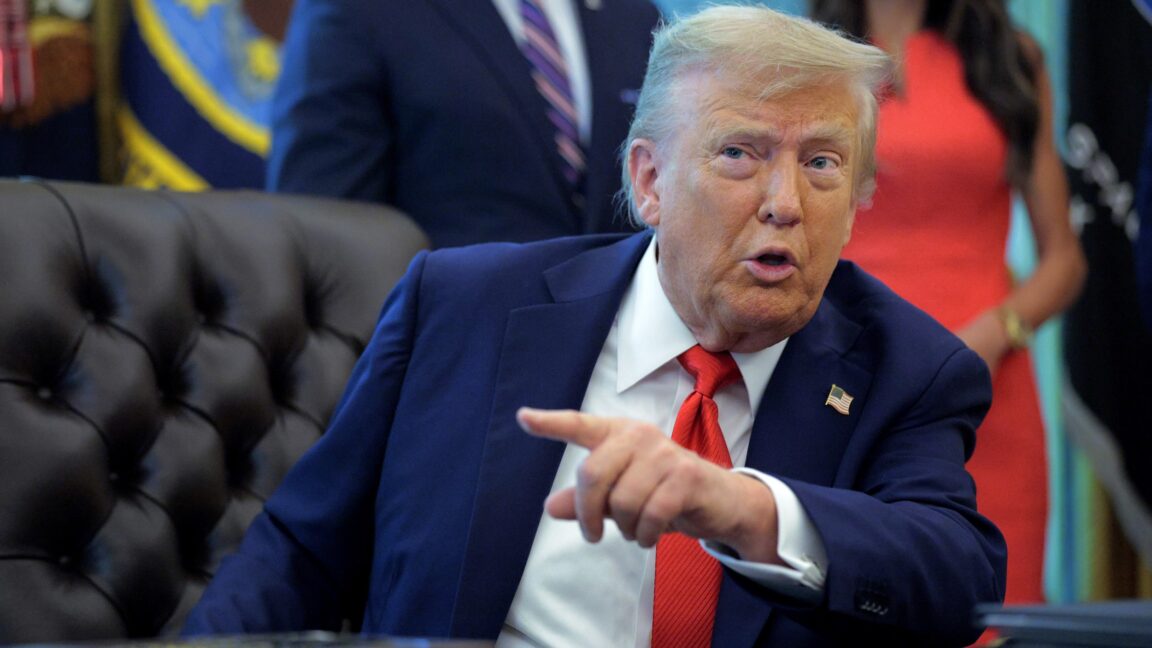

Section 2 of Trump’s order is written vaguely to give the administration leeway to challenge many types of AI laws. “It is the policy of the United States to sustain and enhance the United States’ global AI dominance through a minimally burdensome national policy framework for AI,” the section says.
Colorado law irks Trump
The executive order specifically names a Colorado law that requires AI developers to protect consumers against “algorithmic discrimination.” It defines this type of discrimination as “any condition in which the use of an artificial intelligence system results in an unlawful differential treatment or impact that disfavors an individual or group of individuals on the basis” of age, race, sex, and other protected characteristics.
The Colorado law compels developers of “high-risk systems” to make various disclosures, implement a risk management policy and program, give consumers the right to “correct any incorrect personal data that a high-risk system processed in making a consequential decision,” and let consumers appeal any “adverse consequential decision concerning the consumer arising from the deployment of a high-risk system.”
Trump’s order alleges that the Colorado law “may even force AI models to produce false results in order to avoid a ‘differential treatment or impact’ on protected groups.” Trump’s order also says that “state laws sometimes impermissibly regulate beyond State borders, impinging on interstate commerce.”
Trump ordered the Commerce Department to evaluate existing state AI laws and identify “onerous” ones that conflict with the policy. “That evaluation of State AI laws shall, at a minimum, identify laws that require AI models to alter their truthful outputs, or that may compel AI developers or deployers to disclose or report information in a manner that would violate the First Amendment or any other provision of the Constitution,” the order said.














Leave a Reply