

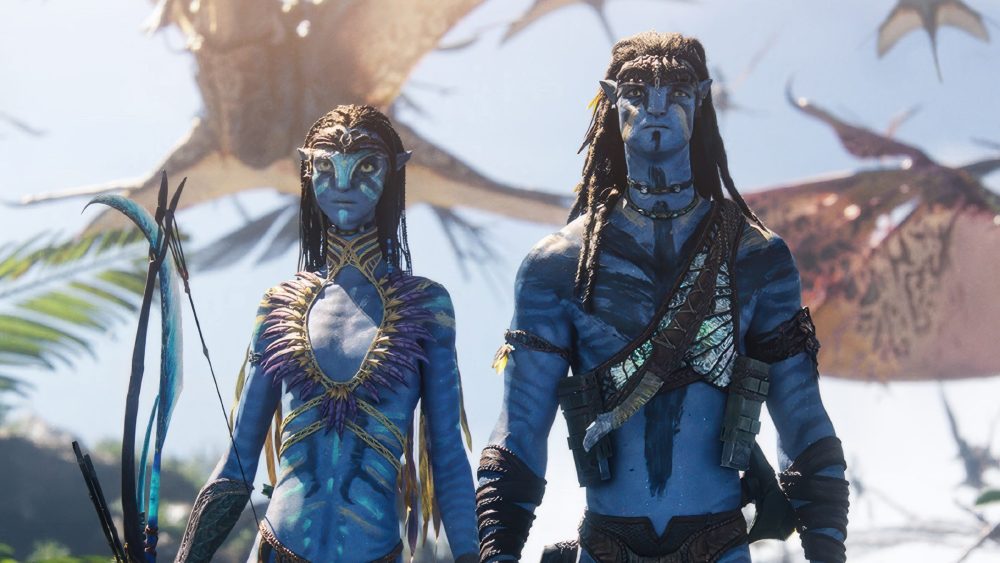
Avatar: Fire and Ash” doesn’t waste any time, starting up right after “Avatar: The Way of Water” ends. Expect James Cameron to blow you away with stunning visuals again, as his team pulls you straight into the incredible world of Pandora.
Picking up right where we left off, the third “Avatar” film in the trilogy follows the Sullys helping Spider (Jack Champion) adapt to his new home on Pandora. Things quickly escalate, though, as a full-scale attack from the Ash People puts Spider’s safety in jeopardy as he is being transported to the High Camp.
The introduction of new biomes and characters allowed the artisans to flex their creative muscles in telling “Avatar’s” story and expand the world beyond Pandora.
As production designer Dylan Cole puts it, “Everything is bigger on Pandora — go big or go home.”
Production Design
Dylan Cole and Ben Procter divide the world-building responsibilities. The human world environments, vehicles and weapons fall under Procter’s charge, while Cole was responsible for designing everything related to Pandora and the Na’vi. “‘Avatar 3’ is a completely different scale,” says Procter. For example, the whale-like Tulkun return, but bigger and more vengeful. “You see an attack, not just by one Tulkun, but by an entire clan.” The Sully kids convince the clan to join Jake and the family as they defend their home.
In one scene, the film’s villains, who run the Resources Development Administration, block the Tulkuns and traps them.
As a battle ensues, the matriarch of the Tulkuns breaches the water and attacks the enemy ship, also known as the factory ship. Procter explains she is 300 feet long and solid meat: “She probably weighs
twice as much as a [RDA] Sea Dragon ship.”
The factory ship was another new vehicle designed for the RDA and their hunting group. As the name suggests, it’s a ship built on an industrial scale at 900 feet long.
“It’s like a mothership, and 72 vehicles live on it.” Procter had initially envisioned it as a floating oil rig, but Cameron felt it “looked too industrial.”
According to Procter, “[Cameron] loves for our vehicles to have that incisive, athletic directionality to them.” Originally, it was meant to be red, but after experimenting with darker charcoal colors, Cameron chose the latter. “It turned out that it was almost animalistic but interpreted through a stealth fighter.”
This felt right and less like a movie prop, blending with the visual language of the Sea Dragon.

Cole remembers a conversation with Jon Landau in 2013, where the producer shared notes that called the film’s Wind Traders “organic living airships backlit by the sun like paper lanterns.”
Cole was instantly excited to design them. The airships, with their beautiful sense of color, were something he leaned into, but it was the hardest thing he had to design. “It wasn’t just one element — it was three. There was the giant living Portuguese man o’ war-inspired airship. Then there’s what we call the gondola, pirate ship-style living village below it.” He continues, “It’s pulled by a second creature called the Windray, which helped steer it, and that was very much inspired by a cuttlefish.” Cole adds, “It was coordinating all those things together.”
Cole made both 3D models and miniatures to test it. On stage, Cole had a huge proxy set of the gondola deck so Cameron could capture sequences. In designing the translucency of the ship, Cole tinkered in Photoshop, trying to balance the transparency. “We absolutely have to think about the composition of the sky so that we know if it’s going to be too busy. Is it going to be too boring? How is it going to show off the silhouette and the backlighting effect? You can’t just design it in a vacuum. You have to design it in context.”

Makeup
The film’s makeup and hair designer, Sarah Rubano, knew Spider had grown up with the Na’vi, so he was trying to emulate them by having body stripes.
Cameron was dedicated to realism, which is why Rubano spent a lot of time doing research and development. She looked at tribal body painting and asked, “Does he apply them? Does he apply them with his fingers? Is he using a tool?”
She worked closely with Weta Workshop, which created the stencils. “We used a very resilient Endura Airbrush Body Art Paint, but developed an Avatar color,” she says. “Avatar blue” was scientific, with white, yellow and black used to achieve that hue. The paint was resilient enough to last through the water work.
Rubano reveals they had over 10 of Spider’s dreadlock wigs at their disposal, “all beautifully custom-made and hand tied.”
She adds, “We had the water wigs, dry wigs and land wigs.” The stunt doubles also needed matching wigs. When it came to the water wigs, Rubano says, “We had wigs with magnets and weights in the dreadlocks so that when he was under water, the dreadlocks didn’t rise to the surface.
They were actually weighted down so that there was lovely movement in the water.” At times, Rubano says she even puppeteered the dreadlocks.

Iva Lenard
Visual Effects

20TH CENTURY STUDIOS
VFX Supervisor Eric Saindon knew the Weta team would have to up their game because “audiences are getting better every year at looking at stuff and going, ‘Oh, that’s fake.’”
Character animation was one of the areas Saindon looked to improve. Stars “Oona [Chaplin], Zoe [Saldaña] and Sam [Worthington] are all very different actors. Sam is very subtle in his performance of Jake Sully. He emotes a lot through his face, but it’s all very subtle, so we’re always upping our game on capturing that information.” Saindon adds, “We want to make sure we see that through to the final character. So we’re always working on our facial performance capture and making sure we get all of that correctly.”
With the characters, Saindon made sur to add small imperfections, from scars to pimples. “It’s those little things that, when we add them, help us make the audience believe those characters are real, even though they’re looking at a nine-foot-tall blue character that you know isn’t real.”
Technology-wise, Saindon says fire was one of the hardest things to do properly in visual effects. Not only do people know what fire looks like, but it never looks the same. “Every time you look at a fire, it could dance a little differently depending on the environment it’s in or burn a different color.” That meant that any scene with fire required them to ensure they were pushing the right amount of fuel and oxygen to get the fire right. “The scale of the embers gives the idea of size,” he says.
Having done water simulations, Saindon found it easier to enhance what they had done previously. With more Tulkuns, scale needed to be shown, but every wave and splash was important. “If you put the same scale of a simulation — like the waves, splash or even the mist — on two different characters and they’re the same, then you’re not going to understand the scale of the character itself.” He adds, “If you get the size wrong, then you really don’t understand the size of the Tulkun, the boat or the ship or whatever character is interacting with them.”

20TH CENTURY STUDIOS
COSTUMES
A new “Avatar” movie meant new char- acters and new costumes for costume designer Deborah Scott to create.
Among the new characters are the Wind Traders, a new group of Na’vi who travel across Pandora on giant airships that look like jellyfish. The captain of the Wind Traders is Peylak (David Thewlis). Scott explains that Peylak’s clan has a “fantastical and jubilant history behind them that we don’t really know that much about, but you can gather that from the visuals.”
The color story was important for Scott. Peylak’s cloak was intense with earth tones. “With Peylak, it’s the colors of a sunrise — very intense.” His cloak was a symbol of his regalness and stature in the clan, prompting Scott to research photos of Indigenous people. “You can see that the colors became very vibrant, so we went with that.”
It was decided that the Wind Traders were a clan that weaves, much like any other clan on Pandora. “Their weaving is very intricate, and they weave cloth.” That idea came from Cameron. “According to Jim’s edict, it’s very cold up there when they fly around. You go to elevation, it gets colder, it gets windy, and they need protection. So that was one of the main ideas behind establishing that clan.”
Cameron also had ideas for Peylak’s collar, but when they came back to “Avatar 3,” he wanted it ot be more regal. “I molded the leather of the collar with beautiful feathers coming at him.”
The inner lining of Peylak’s robe is made from woven fabric, but it was multiple pieces. There were also prints of leaves on the fabric inside.
On the outside, Scott used rustic leather that was then dyed. “The weaving is an applique process. The motif on the out- side of the cloak is very much suggested by two things. One is the wispy clouds. I did research on aerial photography looking down on the world, and when you look down, you see a lot of sinewy rivers and motion. So one of the things I’ve tried really hard to do in the costumes is to not only give them motion — the cloak is very full — but also to give that visual motion, so that your eye is traveling with the color and the swirls.”

Another character Scott designed for was Varang, the leader of the Ash People, played by Chaplin. The idea is they have left and established their community, liv- ing in a volcanic area. “Like all the clans, they make their clothing out of what they find in their environment. So it’s minimal, it’s dark, it’s rustic and they’re dirty,” Scott explains.
Their outfits are made from a combination of worn-down leather, metal, stone and maybe some feathers. Varang’s colors were red and orangey-red. The use of “blood red is a marker of the extreme. It’s on their skin. It’s on their body paint.”
Varang’s costumes and the Ash People were dressed minimally, but the standout was her headdress, one which starts off with a relatively simple design. Scott built the headdresses from a collection of feathers. She’s a little bit of a peacock. She likes to strut about and show her stuff. That one came a lot from Jim. He had suggested the silhouette of the headdress. As we went through the movie and as they went into battle, I said, ‘She needs something. She needs a battle headdress. We’ve got to move away from what she wears every day and give her something even more spectacular,’” Scott says.
Peylak’s cloak and Varang’s costume each took four months to create. But Scott had to go through the process of designing costumes twice. She designed the physical costumes for the actors to wear, and then designed the costume for the virtual world. By having physical costumes, Scott could give all that information of texture, fabric and detail to the virtual artists and have them understand how she constructed the outfits. “We start with the body, then the face and we slowly add the costume pieces,” she says.
The final touch is the color, which they can look at and see whether details need to be made brighter or darker. “It’s quite a process, but it’s like doing the work twice in a completely different way,” Scott says, adding that by giving the virtual artists something physical helps create the believability. “It comes alive to you. You can feel it in your hands. You can see it with your eyes,” she says.











Leave a Reply