

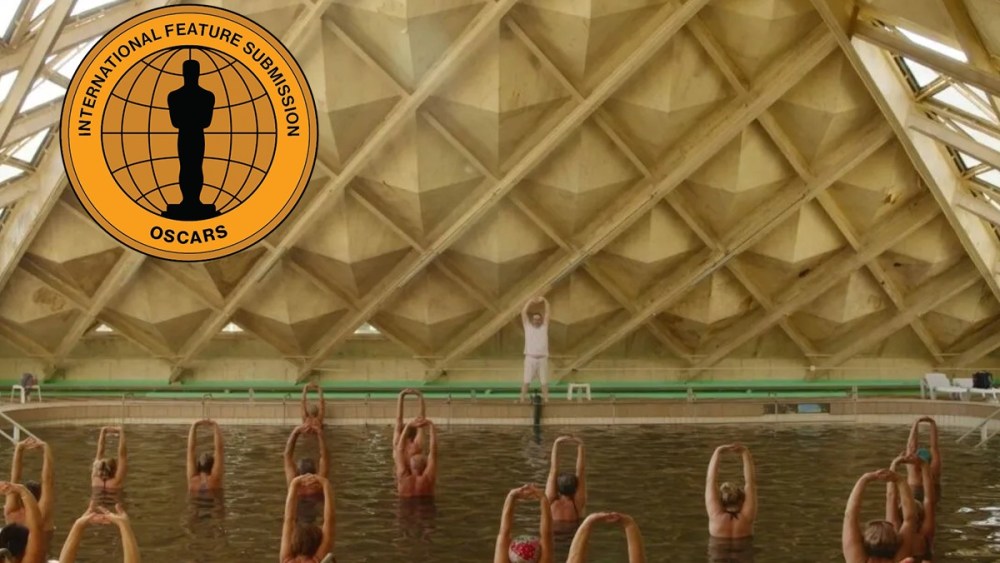
Gar O’Rourke joins the likes of Frederick Wiseman with an immersive observational documentary that takes a sensitive look at a community attempting to relax under conditions of growing unease. Though O’Rourke is an Irish filmmaker, working with majority Irish funding, his chosen location is Ukraine, a country under attack. But this is no front-and-center war documentary. Rather, it’s about what happens outside the combat zones at a faded holiday destination.
To glance at it, the Kuyalnik Sanatorium, located near Odesa in southern Ukraine, could be a power station, military base or even a sewage treatment center. In fact, treatments of another kind draw everyday people to this imposing Soviet-era construction: Mud baths, massages and all sorts of other wellness procedures are the stock in trade of the striking but down-at-heel institution.
Denys Melnyk film’s the facility’s guests with compassion but also honesty, preserving their dignity without airbrushing their reality. The variety of body types and shapes shown here, often covered in very little, is a reminder that despite the smoothness of the people held up as worthy of admiration on Instagram, most people’s bodies and faces have lumps and bumps and creases and crinkles. Showing this in such a contemplative fashion feels quietly radical in an attention economy that has normalized loudness.
With no narrator to impose an interpretation, “Sanatorium” is the opposite of a spoon-fed social issues doc: It observes, listens and trusts the audience likewise to observe, listen and to draw their own conclusions. That’s not to say it isn’t characterful or funny; it is. As guests dance to George Michael’s lush classic “Careless Whisper” at the spa disco, a viewer might recall the Austrian director Ulrich Seidl’s witty scene construction, but where Seidl’s warts-and-all work sometimes crosses a line into mercilessness, the humor here doesn’t erase anybody’s humanity. There’s always a warmth and dignity to the portrayal of the people involved.
There’s even a sense of religious ritual to some scenes: As clients are painted gently with healing mud and wrapped in cloth, it’s like witnessing the embalming of saints, an effect emphasized by Denis Kilty’s score. When the Renaissance painter Caravaggio first started to attract fame, a big part of his appeal was that although his subjects were notionally saints and Biblical figures, his models were everyday people from the streets of Rome, leading to Madonnas with the face of a popular local sex worker, disciples with the frame of the skinny old man selling fish in the market or a prosperous Archdeacon bearing a fleeting resemblance to the proprietor of a nearby dive bar. These are the kinds of faces O’Rourke foregrounds, similarly centering the quotidian to sanctifying effect. This contrasts beautifully with the modest effects of the treatments, as reported by the clients themselves: “Psoriasis is no longer getting worse.”
The location is an important character as well, with the crumbling building itself providing a striking arena for the low-key drama. The ambition and pride that would have been involved in its construction, during the height of the USSR’s power and influence, contrasted with its current state of managed decline, provides a piquant Ozymandias monument: “Look upon my works, ye mighty, and despair” — a topical theme, as aging men in power across the world attempt to ensure they will be remembered, often with harmful consequences.
With values like wit and stoicism baked in, “Sanatorium” always felt like a long shot in the Oscar international feature race, where it is representing Ireland this year. But if the Academy were ever to introduce a category honoring most nuance, this kind of film would be a frontrunner.












Leave a Reply